
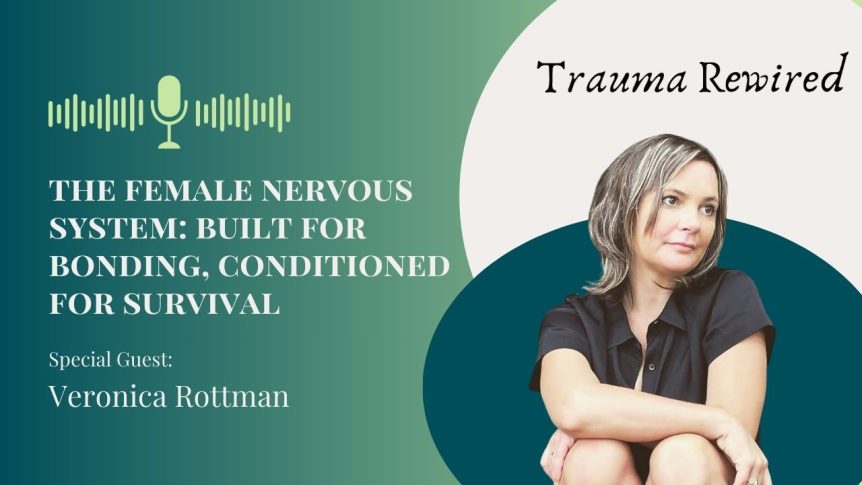
Did you know that women are twice as likely to experience depression, yet less than 40 percent of research includes them? This statistic is staggering, highlighting society’s inadequate attention to women’s mental health and the complexities of their nervous systems. Often overlooked in scientific studies, women’s experiences, particularly regarding menstrual cycles, create significant gaps in understanding their physiological, emotional, and hormonal health. This omission, influenced by societal conditioning and patriarchal suppression, leads to misdiagnosis, unanswered questions, and pervasive shame. However, there’s a growing shift towards understanding the female nervous system.
In today’s episode, Elisabeth and Jennifer are joined by Veronica Rottman, founder of Soma School and an expert in somatics and the female nervous system, to explore how the female nervous system is uniquely structured and the challenges women face because of it.
Their conversation dives deep into the complex science of hormones and societal influences, uncovering how these factors contribute to shame and perfectionism among women. They also examine the male-centric approach of mental health and medical systems, which often overlook—and even demonize—the female experience.
From an early age, women are conditioned to feel shame about their bodies and emotions. However, a growing awareness is challenging these outdated norms. This shift is essential for uncovering the root causes of many mental and physical health issues that are unique to the female nervous system.
If this resonates with you and you’d like to learn more, tune in! Topics discussed in this episode:
- Veronica’s journey to healing her own nervous system through somatic practices
- The history and evolution of women’s health
- Understanding the multilayered and complex nature of the female nervous system
- The differences between oxytocin and dopamine
- An exploration of premenstrual dysphoric disorder (PMDD)
- The role of a dysregulated oxytocin system in attachment
- Why women’s mental health spaces often overlook the impact of the menstrual cycle
- How the patriarchy has historically suppressed women’s emotional expression
- The pathology of women’s emotions and societal perceptions
- Why women experience higher levels of toxic shame
- The connection between shame, perfectionism, and the development of borderline personality disorder later in life
To check out Veronica Rottman’s work, click here to visit her website
Connect with Veronica on Instagram
Free 2-week nervous system training trial
Connect with us on Instagram
Join our Facebook Group