
Why do you know you’re safe logically, but your body still reacts as though you’re in danger?
Emotional regulation isn’t about staying calm, avoiding difficult emotions, or suppressing how you feel. It’s about your brain and nervous system working together to accurately interpret what’s happening inside and around you so you can respond with flexibility instead of survival.
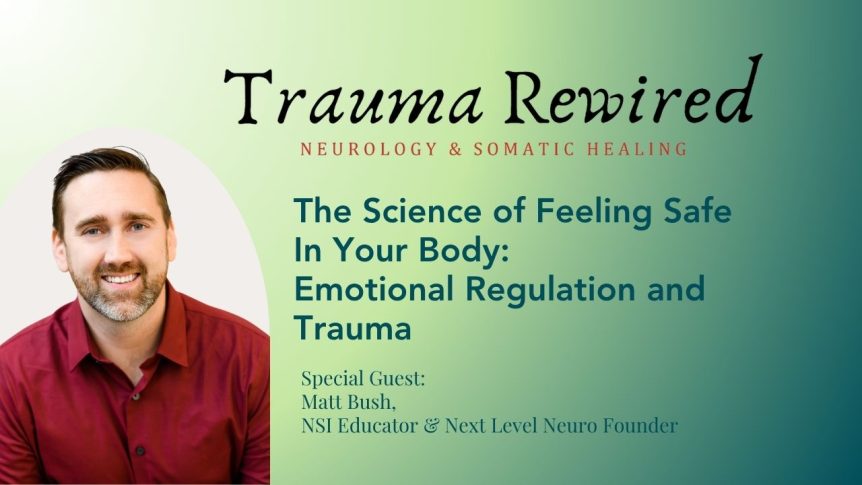
In this episode of Trauma Rewired, Jennifer Wallace and Elisabeth Kristof are joined by NSI educator Matt Bush to explore the neuroscience of emotional regulation through the lens of brain integration, interoception, sensory processing, and neuroplasticity.
Together they unpack why trauma disrupts communication between key brain networks, how chronic stress creates fragmented emotional processing, and why many people remain stuck in cycles of overwhelm, shutdown, perfectionism, dissociation, binge eating, emotional flooding, or emotional numbness despite years of personal development or therapy.
The conversation also explores why emotional regulation is a trainable neurological skill, how simple nervous system practices improve brain integration, why sensory mismatch contributes to chronic stress, and how properly preparing the nervous system creates safer, more effective emotional processing—including during psychedelic experiences.
If you’ve ever wondered why insight alone doesn’t create lasting change, why your emotions sometimes feel bigger than the situation, or why your body seems to react before your mind can catch up, this episode offers a neuroscience-based roadmap toward regulation, resilience, and post-traumatic growth.
In This Episode We Discuss
- What emotional regulation actually is—and what it is not
- Why emotional regulation depends on brain integration
- The roles of the insula, anterior cingulate cortex, cerebellum, and prefrontal cortex
- How trauma disrupts communication between brain networks
- Why chronic stress creates fragmented emotional processing
- The relationship between interoception, proprioception, and emotional regulation
- Sensory mismatch and its hidden impact on nervous system health
- Emotional flooding, shutdown, perfectionism, binge eating, and dissociation
- Why “fake it until you make it” comes with a physiological cost
- The neuroscience behind predictive coding and emotional interpretation
- Why emotions are physiological—not simply psychological
- How movement, vocalization, and nervous system regulation support emotional processing
- Brain-body integration and the limits of insight alone
- Emotional regulation during psychedelic and peak somatic experiences
- Building nervous system capacity through daily regulation practices
- Practical neuroscience tools that support resilience and post-traumatic growth
Featured in This Episode
NSI Foundations Bundle
Learn the foundational neuroscience and practical nervous system tools behind everything taught inside the NeuroSomatic Intelligence Certification.
https://neurosomatic.com/foundationsStart Here
FREE 2-Week Rewire Trial
Learn More About NeuroSomatic Intelligence
https://www.neurosomatic.com
Watch More Trauma Rewired Episodes
YouTube Channel:
https://www.youtube.com/@TraumaRewired
Are you ready to become the woman who can carry the vision? Discover nervous system education, preparation, integration, and resources to support your journey at
https://illuminatedwithjennifer.com
Sacred Synapse with Jennifer Wallace
Learn more about psychedelic neuroscience, applied neurology, Neurosomatic Intelligence, and nervous system-informed psychedelic preparation and integration through educational, harm reduction content.
https://www.youtube.com/@sacredsynapse-23
The Wayfinder Journal
A guided journal designed to help you track nervous system patterns, deepen self-awareness, and support psychedelic preparation and integration.
https://stan.store/illuminated
Connect With Us
Instagram:
https://www.instagram.com/trauma.rewired
Facebook Community:
https://www.facebook.com/groups/761101225132846Exclusive Offer
FREE 1-Year Supply of Vitamin D + 5 Travel Packs from AG1